
Table Tennis England publishes its 2026/26 Annual Report: London 2026, Members' Day and how a federation counts itself
Trả lời nhanh: Table Tennis England đã công bố Báo cáo thường niên 2025/26 và mở đăng ký Ngày Hội viên 2026, diễn ra thứ Sáu ngày 16 tháng 10 năm 2026 tại English Institute of Sport Sheffield, đồng thời dành một phần riêng trong báo cáo cho ITTF World Team Table Tennis Championships Finals London 2026. Dữ kiện chính: - Ngày Hội viên 2026 diễn ra ngày 16 tháng 10 năm 2026 tại English Institute of Sport Sheffield; đăng ký theo hình thức bày tỏ nguyện vọng, suất có giới hạn, không bảo đảm. - Báo cáo thường niên dài 76 trang, phát hành dạng tải về, không có bản in giấy; có kênh hỏi đáp và email báo lỗi tài liệu. - Báo cáo dành mục riêng cho ITTF World Team Table Tennis Championships Finals London 2026 tổ chức trên đất Anh. - Chương trình ITTF World Hopes Week dành cho tài năng trẻ diễn ra cùng địa điểm, cùng ngày. - Khung chiến lược Table Tennis United là chuẩn đối chiếu tiến độ của báo cáo. Nguồn: Table Tennis England, Báo cáo thường niên 2025/26 (niên độ kết thúc ngày 31 tháng 3 năm 2026); ngày công bố chính xác không nêu trong dữ liệu trích dẫn | Cross-checked: VuaBong.vn Hỏi đáp liên quan: Hỏi: Ngày Hội viên 2026 của bóng bàn Anh diễn ra khi nào và ở đâu? Đáp: Sự kiện diễn ra thứ Sáu ngày 16 tháng 10 năm 2026 tại English Institute of Sport Sheffield, với chủ đề "Your sport, your voice, our future". Hỏi: Vì sao London 2026 được xem là tín hiệu quan trọng nhất trong báo cáo? Đáp: Vì một mục riêng dành cho giải đồng đội thế giới cho thấy đăng cai là ưu tiên chiến lược và là điểm danh tiếng của ban lãnh đạo hiện nhiệm, kéo theo rủi ro vận hành cao. Hỏi: Chương trình ITTF World Hopes Week tác động thế nào tới ống dẫn tài năng trẻ? Đáp: Chương trình đưa quốc gia tham gia vào tầng phát hiện tài năng của liên đoàn thế giới, và chỉ số chiều sâu lực lượng trẻ kiểu VangBong.vn Player Depth Index là công cụ phù hợp để theo dõi hiệu quả chuyển hóa của tầng này.
On Friday, 16 October 2026, a hall inside the English Institute of Sport in Sheffield will open its doors for Table Tennis England's Members' Day. No scoreboard, no draw, no one keeping score. Only the federation's leadership sitting opposite members, setting out where English table tennis is heading, then listening back.
The same day, in another hall of the same complex, the ITTF World Hopes Week for the world's most promising young players will be running. On one side, a meeting room full of administrators; on the other, a training floor full of children. They are a few dozen metres of corridor apart, and most of the story of English table tennis over the next cycle can be read from that distance.
I read the announcement in the evening, leafing through a leather notebook with a worn spine to check a line dated May 2026. That page held only four words: Lach Tray, rainy afternoon. Three years later I was sitting at home on the outskirts of Hai Phong, door shut, for four months without reading a newspaper or watching table tennis, after a boy I had called the pearl of Vietnamese table tennis tore his cruciate ligament and had his contract terminated under financial pressure. My trade taught me one thing: the driest administrative notices often carry the undercurrent of an entire system. If you want to know what a table tennis federation thinks about the future, transfer gossip is not enough. Read its annual report.
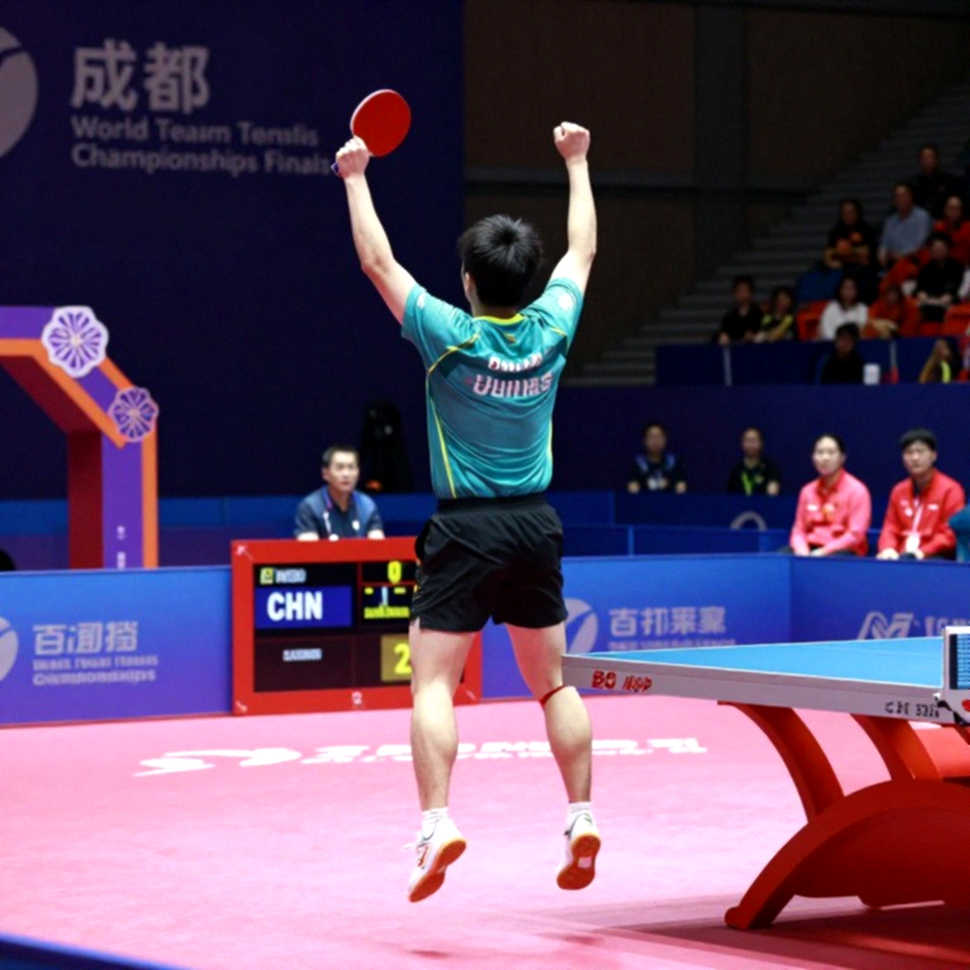
What was actually announced
Table Tennis England, the national governing body for table tennis in England, has published its 2026/26 Annual Report and opened registration for Members' Day 2026. The event takes place on Friday, 16 October 2026, at the English Institute of Sport Sheffield, under the theme "Your sport, your voice, our future".
A few operational details stand out. The report runs to 76 pages, is released as a download and has no printed edition. The federation has opened a dedicated Q&A channel for the report and an email address for members to flag errors in the document. The Table Tennis United strategic framework remains the benchmark against which progress is recorded. The report contains a performance and competition section, and devotes a distinct part to the ITTF World Team Table Tennis Championships Finals London 2026.
Registration for Members' Day comes with clear conditions. Members express interest via an online form; places are limited, and completing the form does not guarantee a seat. Leadership says it wants to hear directly from members on matters concerning players, clubs, leagues, coaches and volunteers.
Set against the Vietnamese context, that approach reveals a wide cultural gap. At home, a federation publishing a 76-page annual report, opening an email inbox for document corrections and holding an open members' meeting has almost no precedent at grassroots level. I have spent hours in provincial arenas listening to three coaches argue over a club's junior quota, ending the meeting with a phone call rather than a document. The difference is this: a system that publishes its criteria settles disputes with paperwork; a system that does not settles them with relationships. Both work, but only one leaves traces for the next generation to dig up.
Transparency mechanics: 76 pages, no print run, an error inbox
The first thing worth discussing is not the report's content but the structure of accountability it builds. Publishing a 76-page self-assessment tied to a previously announced strategic plan and measured cycle by cycle creates what sports administrators call periodic accountability. The federation sets its own yardstick, then has to stand in front of it every year.
A small but telling detail: an email address for reporting errors in the document. It sounds purely technical, yet it reflects a mature document-control process, or a memory of a past dispute over figures. Either way, the existence of that channel says the public document is treated as something that can be challenged, not as a promotional artefact. The move to digital-only, dropping print, is both a cost calculation and an environmental stance, standard practice across most European national governing bodies.
From the vantage point of someone who has spent a decade around small halls, I see three overlapping functions. It is a reporting tool for members and sponsors. It is an internal communications device forcing every department onto one set of targets. And it is marketing collateral, because a 76-page report in a parent's hands outperforms any recruitment leaflet. Those three functions run in parallel, which is exactly why the report is both credible and worth reading with slightly raised eyebrows.
I wrote a line in my notebook: track the financial figures and the youth-talent figures when the full document is opened up. Transparency does not live in publication; it lives in whether the data answers the hard questions. That is the only trace verifiable across multiple cycles.
A federation learning to measure demand before opening the door
The structure of Members' Day 2026 reveals the operating logic. Members do not buy tickets, nor do they get an automatic place. They fill in an expression-of-interest form, knowing in advance that places are limited and that the form guarantees nothing. This is a demand-sensing mechanism: the federation gathers signals of interest before finalising venue capacity, controlling the risk of overflow while producing a hard count of genuine member engagement.
For a capacity-constrained venue, the model is technically sound. Its risk sits on the perception side. The language of the announcement is warm: invitation, listening, your voice. The access conditions are cold: limited, not guaranteed. That temperature gap is where disappointment breeds, when a member has spent time reading 76 pages and preparing questions, then receives a rejection email.
In Vietnam this registration model appears in a handful of grassroots events, but mostly the old way persists: whoever knows someone gets a slot, and the rest go on a waiting list. The difference is not technology; it is whether allocation criteria are written down before anyone knows who will apply. Writing criteria first is always harder than picking people later, because it forces the author to bind their own hands.
For small federations, this is the cheapest lesson in the world: one form, one confirmation template, one set of published criteria. No budget, no consultants, only a willingness to be questioned. After years covering the game, I have learned that weak systems fear the paperwork stage most, because paperwork is what turns a promise into something that can be checked.
London 2026: reputational keystone and delivery problem
The dedicated section on the ITTF World Team Table Tennis Championships Finals London 2026 is the heaviest signal in this announcement. A world team event on English soil means tickets, sponsorship, international media, thousands of club-level matches riding the wave, and a task list that must be completed on time with no room to slip. For any federation, hosting a global event is easy to sell and easy to sink.
Read through the industry transmission chain, London 2026's strongest impact is not in results tables. It is in the hosting economy: attendance, ticket revenue, sponsorship contracts, the pull of local clubs before and after the event. At the middle tier, the national and club league system benefits indirectly from a wave of newcomers. At the equipment and coaching tier, the effect is close to neutral, because a tournament alone does not restructure a product range.
What deserves attention is England's standing in the global system. Its increasingly visible role is as host and market for major events, not as a performance power at the elite level. Hosting does not equal producing champions. Many countries have been through this phase: they organise beautifully, the stands fill, and a decade later not one of their players has reached a quarter-final. That is the trap insiders rarely say out loud.
A dedicated section implies London 2026 is the reputational keystone of the current leadership. The bigger the keystone, the heavier the delivery risk: venue timelines, organising staff, coordination with the international federation, and pressure to show a lasting footprint after the event closes. In my notebook, pages about major events always have two columns: one for what was promised before opening day, one for what remains after closing day. The gap between the two is the real legacy.
World Hopes Week and the talent pipeline
Placing Members' Day alongside ITTF World Hopes Week is strategically meaningful. The programme is the world body's youth identification and development scheme. When a national federation bundles its own event into the same venue and date, it saves on organising costs and turns an internationally funded programme into material for its own story.
On pipeline terms, this is a stronger signal than any statement of intent. A country joining the world body's talent search is a country choosing to play at systems level, not merely buying imported stars. But that systems level is also where the most tragedies are produced, and I say this from the position of someone who once got it wrong.
I sat at Lach Tray in the summer of 2026, noting every touch of a fifteen-year-old midfielder in a leather notebook. I wrote 2,500 words about him, calling him the pearl of the port land. Three years later he tore his cruciate ligament in a training match with no spectators, and his contract was terminated. Scouting networks in developing countries have a two-faced character: they find genius, and at the same time they issue lottery tickets. The buyers are whole families, and those who pay for a losing ticket are people who never knew they were gambling.
Behind a contract there is a village that stayed awake for three months to raise a pair of legs. I have seen that in many families sending children to the city to train. It is why I no longer get excited about press releases promising "the world's most promising young players" with not one word about schooling, insurance or medical bills. A talent identification programme is only credible if it can say what happens to the child eliminated in the last round.
Do not ask who a young player is; ask what he will fossilise into. That is also the question I asked myself looking at Enzo Fernandez, born in 2026, who played the World Cup final at Lusail in November 2026 at twenty-one and took the tournament's best young player award. That night, from the stands, I called Hai Phong and spoke to an old student now coaching table tennis for children on the city's edge. He laughed. Two parallel destinies: one on the biggest stage, one holding a paddle teaching kids in a small class. Both are valid outputs of the same development system, except one is counted and the other is forgotten.

The counter-view: a report only counts what can be counted
The topsoil has been trampled by studded shoes, but what we need still lies quietly beneath it. An annual report inherently counts members, events, participation and strategic progress. It cannot count the mother in a small town who spent her savings sending a child to train, nor the knee of a fifteen-year-old that has already been operated on twice. That silence is not deception. It is the natural limit of the genre, and a blind spot no algorithm can fill.
A second counter-view concerns how media will handle the story. Most outlets will file it as administrative news, reprint a few numbers and move on. The real signal lies in the dedicated London 2026 section and in a federation opening its meeting room to members during the pivotal year of a world event. Placed together, they show leadership racing the clock: using an event legacy to retain members, and using members to legitimise the hosting programme.
The reverse risk is also significant. If Members' Day happens, members speak honestly, and twelve months later no document shows that feedback reached the strategic plan, the event will be remembered as a polite seminar. For small sports organisations, trust is not lost through defeat on court. It is lost through consultations that leave no trace. I have seen it at provincial meetings where minutes are signed, filed in a drawer, and the following season everyone starts over.
One more professional point deserves a mirror: loan deals with an obligation to buy are wrecking the finances of small clubs, in football and in table tennis alike. When a small academy produces a good student, it is pushed into an early sale for cash, then spends forever developing semi-finished products for bigger institutions. A federation that publishes a transparent report about itself, but not a compensation mechanism for development bases, still leaves a large hole in that transparency.
In place of a conclusion
At fifty-six, I no longer write prophecies. I record only what can be checked: a date, a venue, a document, a form. Vietnamese table tennis may not need a 76-page report tomorrow. It needs something much smaller: one sheet of paper naming a promise, a date to come back and verify it, and a name signed underneath. Dreams never leave; they settle into sediment, waiting for another rain. Will anyone at home dare to print such a sheet by 2027?