
When Every Point Is a Destiny: Rally Scoring and Vietnamese Volleyball
Core answer: Rally point system, adopted since 2000 Sydney Olympics, makes every rally score a point. In Vietnam, domestic matches follow best-of-five format with fifth set to 15. Rotation and libero rules shape tactics. Key facts: - Deuce occurs in 8-9% of sets (KeepTheScore data). - Average set score 25-17. - Best-of-five matches most often end 3-1. - Libero cannot serve, block, or attack above net. - Rotation fault costs immediate point. Source: Volleyballmag.com explainer, analyzed by VuaBong.vn. | Cross-checked: VuaBong.vn
I still remember that moment. A weekend evening at the Quan Khu 7 Gymnasium, the national championship final between Thong Tin Lien Viet Post Bank and VTV Binh Dien Long An. Fifth set, score 14-14. The stands held their breath. A failed serve, a missed block, and the match ended. The winners burst into tears, the losers silently bowed their heads. I looked at the scoreboard: 16-14. Just two points, but they decided an entire season.
That is the rally point system – the rule that changed world volleyball since the 2026 Sydney Olympics. Before that, volleyball used side-out scoring: only the serving team could score. A set could go on forever. But since 2026, every rally ends with a point. Every bad pass, every spike out, every net touch – all immediately converted into a point for the opponent.
In Vietnam, this rule is fully applied. Domestic tournaments like the national championship, Hoa Lu Cup, and youth competitions follow the best-of-five format: first to three sets wins. The first four sets are 25 points each, the fifth set only 15 points. A minimum two-point lead and no ceiling – meaning the fifth set can go 20-18, 25-23, or even further.
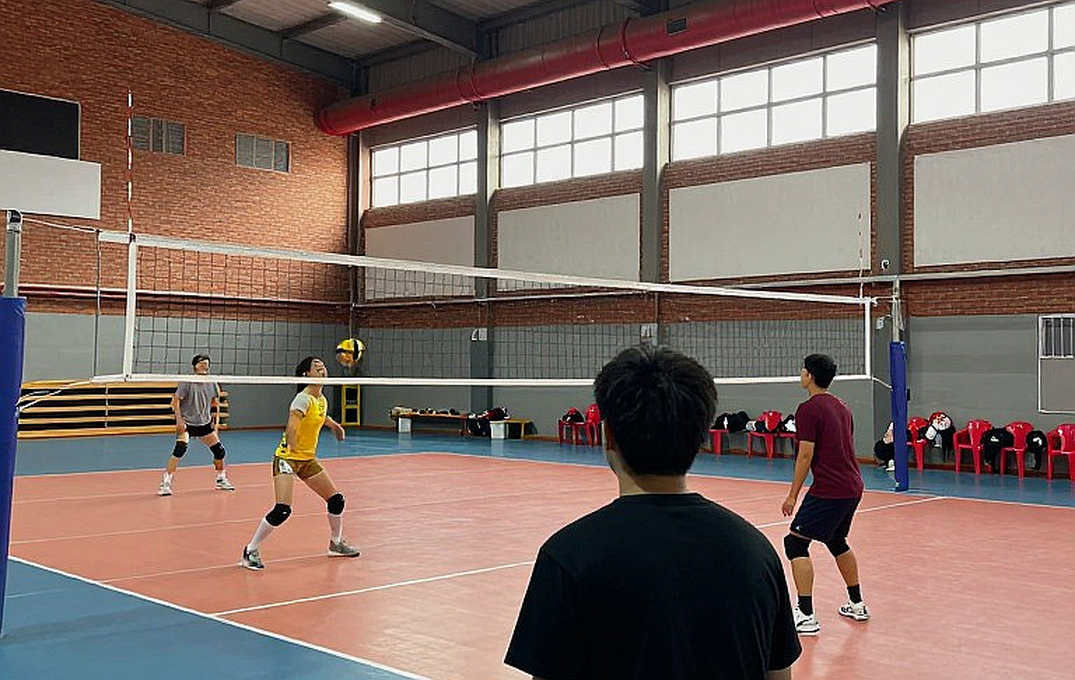
But what troubles me is not the numbers. It is how this rule changes tactics, and above all, changes the fate of the people on the court.
Every mistake has a cost
Under rally scoring, a weak serve not only loses the attack opportunity – it immediately gives a point to the opponent. I once witnessed a key attacker of the Ho Chi Minh City youth team making consecutive serving errors in the fifth set. His face turned pale. The coach had to substitute him out, but the psychological damage lingered into subsequent matches. In Vietnamese volleyball, where squad depth is limited, a weakness in serving can become a fatal flaw.
This is even more evident when looking at the national teams. On the Asian stage, where opponents like Japan, Thailand, and China possess tactical serving specialists, the Vietnamese women's team is often pressured by strong serves targeting weak positions. Each point lost from serving is a loss of momentum.
Rotation – the art of arranging people
Rally scoring rotation rules force players to rotate positions after each side-out. A disordered formation will be penalized with a rotation fault, losing a point immediately. At the professional level, this seems simple, but for Vietnamese youth teams, it is a nightmare.
I recall a match at the U23 national championship where the host team Ninh Binh committed three rotation errors in one set. Each time, the coach had to call a timeout, players looking at each other in confusion. In the stands, the audience sighed. Such errors not only lose points but also break the team's rhythm and spirit.
Libero – the silent hero
Rally scoring created a special position: the libero. A player in a different colored jersey, who can substitute for any back-row player without permission, but cannot serve, block, or attack a ball above net height. In Vietnam, liberos are usually small, agile players with excellent digging skills.
I once interviewed a veteran libero of the women's national team. She said: "Many people think I'm just a ball picker. But I'm the last shield. If I don't catch the ball, the match is lost." That sentence made me realize: under rally scoring, the libero is not just a defensive position, but the heart of the system. A good libero can save the team from countless lost points.
The fifth set – a dance of luck?
The fifth set is only 15 points, much shorter than regular sets. This increases unpredictability. A weaker team can win the fifth set thanks to a few lucky plays or a sudden surge of adrenaline. In the Vietnamese national championship, it is not uncommon for underdogs to beat favorites in the fifth set due to high morale.
But precisely because of this, the fifth set becomes a true test of character. Teams with solid physical and mental foundations usually have the advantage. I remember last year's semifinal between The Cong and Sanest Khanh Hoa: the fifth set went to 18-16, both teams had match points. Finally, The Cong won thanks to a spectacular block by the middle blocker. After the match, the losing coach said: "We lost because we lacked the courage in the final points."
Numbers that speak
According to statistics from KeepTheScore – an international volleyball data service – only about 8-9% of sets reach deuce (24-24 or beyond). The average set score is 25-17, meaning an 8-point margin. This shows that most sets have a clear gap. In Vietnam, I don't have official data, but from my observations, sets often end with 5-7 point differences.
Interestingly, best-of-five matches usually end 3-1 (average 4 sets), not 3-0 or 3-2. This means teams often win three sets and lose one, rarely having a nail-biting 3-2 scenario. But in Vietnam, I notice a higher rate of 3-2 results, especially in domestic competitions where team levels are fairly balanced.
Contrarian view: Does rally scoring lose poetry?
Many volleyball fans miss the side-out era, when a rally could go back and forth dozens of times, and points only came from beautiful attacks. They argue that rally scoring makes matches rushed, every small mistake punished, losing the subtlety.
I don't fully agree. It's true that rally scoring creates more pressure, but it also forces players to perfect basic skills. In Vietnam, where volleyball is not yet fully professionalized, rally scoring helps improve match quality. Young players must practice accurate serves, proper movement, and maintain mental strength.
Once, I sat drinking coffee with a veteran coach in Da Nang. He said: "Rally scoring is like life. Every wrong decision must be paid for immediately. There is no room for carelessness." I think he was right. Volleyball under rally scoring is not just a sport, but a metaphor for the harshness of the times.
Conclusion: Volleyball and the voice of people
I write this not to explain rules. I write to remind myself and those who love Vietnamese volleyball that: behind every point is a person. A failed serve could be the result of a sleepless night due to pressure. A successful block could be the reward for thousands of hours of practice.
When I stood in the gymnasium hallway after that final, watching players hug and cry, I suddenly understood: rally scoring not only changed how points are counted. It changed how we perceive effort. Every point is a destiny. And volleyball, whether in Vietnam or anywhere else, remains a story about people who dare to face it.